18th Century Jesuit Theology Manuscripts of Gaspar de Segovia, Professor at Rome’s Collegio Romano Before the Suppression of the Jesuits
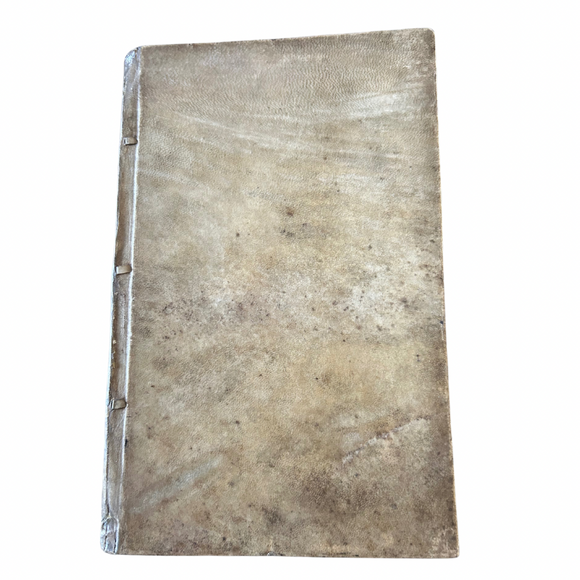
1479On offer is a substantial two-volume Latin manuscript courses in dogmatic and sacramental theology, written in a clear 18th century hand and preserved in matching vellum bindings. The handwritten spine titles read Segovia de Deo [Segovia Concerning God] and Segovia de Sacram. in gen. [Segovia Concerning the Sacraments in General].
Together, the volumes contain 636 numbered manuscript pages. They preserve theological courses attributed to the Spanish Jesuit Gaspar de Segovia y Juvero, S.J. (1721/1722–1802), who taught theology at Zaragoza and later served as Public Professor of Sacred Theology at the Collegio Romano [Roman College] in Rome.
The manuscripts were formerly associated with the fifteenth-century theologian John of Segovia. The text rules out that attribution. In the first disputation, Thomas Hobbes (1588–1679) and Baruch Spinoza (1632–1677) identified and said to have been working in “the century elapsed before ours” (elapso ante nostrum sæculo), dating the course to the eighteenth century.
It is not known whether Segovia delivered these courses at Zaragoza or at the Collegio Romano. Both volumes contain direct addresses to students, confirming their classroom purpose. In Volume I he writes, “vestris animis insideat velim” [“I would wish it to be deeply seated in your minds”].
As a pair, the volumes preserve a substantial record of Jesuit theological teaching and scholarly thought in the eighteenth century.
Manuscript Descriptions
Volume I: Tractatus de Deo [Treatise on God]
The first volume contains 333 pages on the existence, nature, knowledge, will, and attributes of God. Its opening plan sets out six disputations, ending with the Trinity. The text stops during the fifth disputation, in a section on divine omnipotence.
Segovia begins by asking how human language can describe an infinite and incomprehensible God. His preface draws on Scripture, the Church Fathers, the Fourth Lateran Council, Plato, and Hermes Trismegistus. He answers the problem with Augustine’s paradox:
Si enim ineffabile est quod fari non potest, non est ineffabile quod vel ineffabile dici potest. [If that is ineffable which cannot be spoken, then that which can even be called ineffable is not ineffable.]
The first disputation addresses the existence of God. Segovia answers ancient sceptics, including Protagoras and Diagoras, as well as Hobbes and Spinoza. He also uses Cicero’s argument that the beauty and order of the heavens point to an eternal divine nature.
Much of the volume concerns divine knowledge, predestination, grace, and human freedom. A section titled Scientia Media, seu futurorum conditionatorum contingentium [Middle Knowledge, or Future Conditional Contingents] considers how God knows what free creatures would do in circumstances that never occur.
Segovia illustrates this question through David at Keilah. David already knew that Saul was approaching. He also had no reason to believe that the grateful Keilites presently intended to betray him. His question was conditional: quid sibi, si intra urbis illius moenia permaneret, esset futurum [what would happen to him if he remained within the walls of that city]. God revealed what the Keilites would do if David remained and Saul arrived. David then fled, so those circumstances never arose.
Other sections discuss divine foreknowledge, the early death of the righteous, predestination, grace, and final perseverance. The volume closes with De Omnipotentia Dei [On the Omnipotence of God]. Its final argument, drawn from Augustine, is that divine wisdom is present in small works as fully as in great ones.
Selected Excerpts from Volume I follow:
Præstantem aliquam æternam naturam, et eam suspiciendam adorandamque hominum generi, pulchritudo mundi, ordoque rerum cælestium cogit confiteri.
[The beauty of the world and the order of celestial things compel the human race to confess that there is some pre-eminent and eternal nature, worthy of reverence and adoration.]
Prædestinatio fert secum absolutam, et efficacem electionem, præparationemque mediorum, quibus certissime liberentur, quicumque liberantur.
[Predestination carries with it the absolute and efficacious election and preparation of the means by which those who are delivered may most certainly be delivered.]
Numquid Deo quidquam est difficile? Numquid manus Domini invalida est? Scio quia omnia potes. Apud homines hoc impossibile est; apud Deum autem omnia possibilia sunt.
[Is anything difficult for God? Is the hand of the Lord powerless? I know that Thou canst do all things. With men this is impossible; with God all things are possible.]
Ita est artifex magnus in magnis ut minor non sit in parvis; quæ parva non sua granditate (nam nulla est), sed artificis sapientia metienda sunt.
[As the craftsman is great in great things, so he is not less in small things; and these small things are not to be measured by their own magnitude, which is nothing, but by the wisdom of the craftsman.]
Volume II: Tractatus de Sacramentis [Treatise on the Sacraments]
The second volume contains 303 pages on the nature, operation, administration, and effects of the sacraments. Its preface traces the word sacramentum from Roman law, through its biblical use for the Greek mysterion, to its Catholic meaning.
The course is divided into seven broad parts. These cover the power of the sacraments; their matter and form; their number and necessity; sacramental grace and character; their recipients; Christ as their institutor; and their ministers.
Segovia defines a sacrament as a visible and effective sign of sanctity instituted by God. He then tests this definition through objections and replies, using the standard forms Dices [You will say], Respondeo [I answer], nego [I deny], concedo [I concede], and distinguo [I distinguish].
One section concerns the obex [impediment] that prevents sacramental grace. Segovia distinguishes a positive obstacle, such as grave sin, from the absence of a required disposition. He also discusses the operation of Baptism and Penance after an impediment has been removed.
Another section addresses the sacramental “character,” or permanent spiritual mark conferred by Baptism, Confirmation, and Holy Orders. Against the opinion attributed to Duns Scotus that this character is only a relation, Segovia argues that it is something real and enduring in the soul.
The later sections examine the intention of the minister. Against Ambrosius Catharinus and Marcantonio de Dominis, Segovia argues that the correct words and actions are insufficient if a priest secretly withholds the intention to baptize. He also considers consent and coercion through the cases of amentes [the mentally incapable], dormientes [the sleeping or unconscious], and reluctantes [those actively resisting].
Selected Excerpts from Volume II follow:
Pro rei ipsius dignitate iuxta ac utilitate vestrum omnium penitius intelligatis.
[So that all of you may understand them more deeply, according to the dignity and usefulness of the subject.]
Sacramentum antonomastice dictum signum est sensibile, et practicum veræ sanctitatis, à Deo pro hominibus institutum.
[A sacrament, properly so called, is a sensible and practical sign of true sanctity, instituted by God for humankind.]
Ut characteres, quibus miles, et ovis extrinsecus insigniuntur præter respectum, quem alter ad Principem, alter ad possessorem habent, aliquid in semetipsis sunt reale, et absolutum; sic sacramentalis character præter ordinem, aut respectum, quem ad sacra ministeria dicit, aliquid esse debet reale, absolutum, animæ inhærens, physice perseverans.
[As the marks by which a soldier and a sheep are externally distinguished are, beyond their relation to the prince or owner, something real and absolute in themselves, so the sacramental character, beyond its relation to sacred ministries, must be something real, absolute, inhering in the soul, and physically enduring.]
Significance: These volumes preserve the form of advanced Jesuit theological teaching before the suppression of the Society of Jesus in 1773. Their prefaces, syllabi, numbered disputations, objections, responses, and direct addresses to students reflect their classroom use.
Segovia’s known printed works are limited. A preliminary search has not located another manuscript witness of either course. The volumes therefore appear to preserve a largely unpublished part of his teaching. They offer research material on Jesuit education, eighteenth-century scholasticism, scientia media, predestination, sacramental theology, and Catholic responses to Hobbes and Spinoza.
Translation Note: The English translations were prepared with the assistance of online translation software and checked against the context of the manuscript.
Physical Description:
Two Latin manuscript volumes on laid paper, quarto, each measuring approximately 26.5 × 20 cm (10.4 × 7.9 inches). Volume I, Tractatus de Deo, contains 333 numbered pages. Volume II, Tractatus de Sacramentis, contains 303 numbered pages.
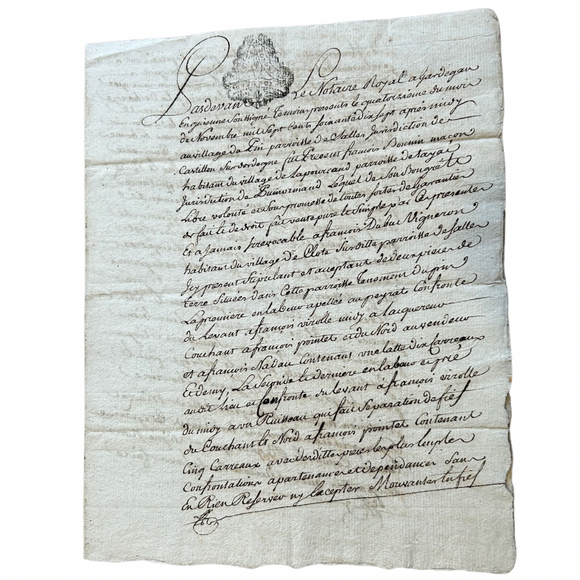
Both volumes are bound in period vellum with handwritten titles on the spines. The writing is formal, consistent, and highly legible. Headings, disputations, sections, propositions, objections, and responses are clearly marked. Small corrections appear throughout.
The endpapers contain a faint crowned heraldic watermark. Visible elements include castles, lions, fleur-de-lis-like devices, possible eagles, a cross, and three horizontal circles within borders. A loose sheet with additional related content is tipped into Volume II.
Condition: Overall Very Good. The vellum bindings show mostly light surface soiling consistent with age and use. There is a single wormhole in the vellum and occasional minor interior faults. The manuscript text remains generally clean, highly legible, and well preserved. The loose sheet in Volume II is retained in its present position.
Biographical Notes
Gaspar de Segovia y Juvero, S.J. (1721/1722–1802) was a Spanish Jesuit theologian, preacher, and professor. A Jesuit archival notice records his birth at Zaragoza on 22 January 1721 and his entrance into the Society of Jesus on 14 March 1735, at the age of fourteen. Some later Jesuit bibliographies give his birth year as 1722, which accounts for the conflicting dates in modern records (Wicki, 1988, p. 309; Álvarez de Miranda, 2015, pp. 19–20).
The Aragonese bibliographer Félix de Latassa stated that Segovia belonged to the family of the Barons of Torrefiel. There is no evidence that Segovia himself held the title. He received his doctorate in theology from the University of Zaragoza on 7 August 1746. He also served as a calificador, or sworn theological examiner, for the tribunal of the Holy Office in Aragón (Latassa y Ortín, 1802, pp. 86–87).
Segovia taught philosophy and theology at the Jesuit College of Zaragoza. He was also known for his work in the humanities, sacred oratory, history, and literature. He belonged to Zaragoza’s Academia del Buen Gusto. His oration Triunfo de María en su Concepción Inmaculada was printed at Zaragoza in 1756 (Álvarez de Miranda, 2015, pp. 19–20).
He was later called to Rome. Latassa reports that he taught for seven years at Zaragoza and eleven years at Rome. Segovia’s 1795 title page identifies him as a former Public Professor of Sacred Theology at the Collegio Romano.
Segovia was living in Rome when the Spanish Jesuits were expelled from the dominions of Charles III in 1767. Miguel Batllori cites a letter sent during the crisis to “Father Gaspar de Segovia, resident in Rome” (Batllori, 1966). A Jesuit account from June 1773 also places him in Rome and describes him as a former colleague in theology of Giacinto Stoppini, rector of the Roman College (Wicki, 1988, p. 309). The Society of Jesus was suppressed later that year.
In 1795 Segovia published his Dissertatio de opinione probabili at Rome. It answered the Dominican theologian Pietro Maria Gazzaniga’s lecture on probable conscience. The book also included an appendix on the marriage of Ramiro II of Aragón, who had been a monk, priest, and bishop before becoming king.
By 1800 Segovia had returned to his family home in Zaragoza, where Latassa reported that he was still living. Later Jesuit bibliography gives 1802 as the year of his death. Zaragoza is the probable place, although an exact contemporary death record has not yet been identified.
References
Álvarez de Miranda, P. (2015). Los componentes de la Academia del Buen Gusto de Zaragoza. In M. D. Gimeno Puyol & E. Viamonte Lucientes (Eds.), Los viajes de la razón: Estudios dieciochistas en homenaje a María-Dolores Albiac Blanco (pp. 9–36). Institución Fernando el Católico. https://ifc.dpz.es/recursos/publicaciones/35/00/02alvarezdemiranda.pdf
Batllori, M. (1966). La cultura hispano-italiana de los jesuitas expulsos: Españoles, hispanoamericanos, filipinos, 1767–1814. Editorial Gredos.
Latassa y Ortín, F. de. (1802). Biblioteca nueva de los escritores aragoneses que florecieron desde el año de 1795 hasta el de 1802 (Vol. 6, pp. 86–87). Oficina de Joaquín de Domingo. https://archive.org/stream/bibliotecanueva00ortgoog/bibliotecanueva00ortgoog_djvu.txt
Segovia, G. de. (1795). Dissertatio de opinione probabili cum appendice super Ranimiri II. Aragonum regis X. monachi, sacerdotis, et episcopi matrimonio: Adversus theologicam de conscientia probabili praelectionem clarissimi Gazzanigae. Ex Typographia Pauli Junchi. https://oseegenius.unigre.it/pug/resource?uri=79265BIB&found=1
Wicki, J. (1988). Le «Memorie» dei penitenzieri gesuiti di S. Pietro. Archivum Historicum Societatis Iesu, 57, 263–313. https://archive.org/details/ahsi-1988
Please don't hesitate to contact us for more information or to request photos. (Kindly include the SKU, listed on this page above the price, in your e-mail so we can more easily answer your questions.)