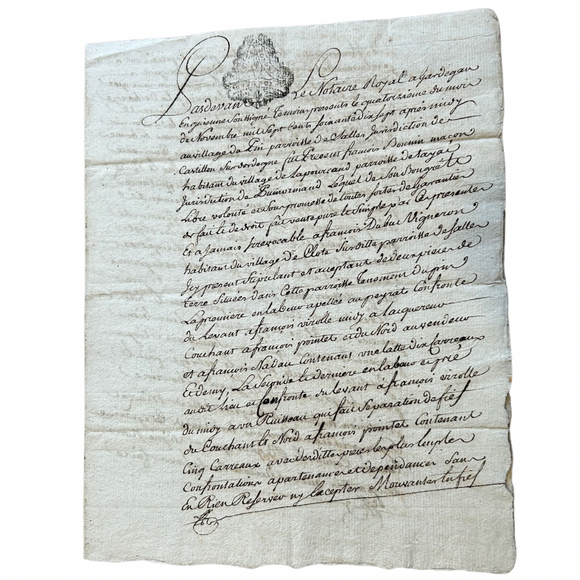
1737 Extensive Norman Seigneurial Court Manuscript Reclaiming and Inventorying 158 Properties for Unpaid Feudal Rents and Duties
00JT37On offer is an extensive 44-page manuscript record of a seigneurial court convened in Normandy on May 21, 1737, documenting the legal reclamation of numerous properties whose occupants had failed to pay rents, submit declarations of tenure, or perform the duties required under the region’s surviving feudal land system.
The court assembled at approximately ten o’clock in the morning at the manor of the Seigneury of Mortemer. It was presided over by Louis-Érard Lamperierre, avocat au Parlement, acting in the absence of the regular seneschal. Also participating were Jean-Baptiste Combault, prosecutor and receiver of the seigneury; Antoine Jouin, Royal Notary and ordinary court clerk; François Osmont, Esquire and Lord of Mortemer; and Jean-Baptiste Lignel, Royal Sergeant in the Viscounty of Moyaux.
At the centre of the proceedings was a legal process called réunion, through which neglected lands could be reclaimed and incorporated into the lord’s direct, unenfeoffed domain. Osmont alleged that the properties’ occupants had failed to provide their aveux (formal declarations recognizing the lord’s authority) and had left their seigneurial rents, dues and obligations unpaid.
The manuscript records the unusually public procedure required before the lands could be reclaimed. Lignel appeared before the court with three separate reports demonstrating that he had announced the proceedings outside the parish church following Mass on three consecutive Sundays: March 24, March 31 and April 7. These “cries and proclamations” notified the inhabitants of the date, place and purpose of the approaching court session.
When no occupants appeared to submit their declarations or discharge their debts, the court ruled that the required proceedings had been properly completed according to the Custom of Normandy. The properties were consequently declared reunited with the seigneurial domain, and the lord was placed in legal possession of them. The judgment prohibited others from interfering with that possession but provided a mechanism through which former occupants could seek to be re-enfeoffed after paying the associated expenses.
The remainder of the manuscript forms an extraordinary numbered inventory extending to at least 158 entries. Individual parcels are described according to their acreage, cultivation, buildings, neighbouring proprietors and physical boundaries. The lands include ploughed fields, pastures, courtyards, orchards, houses, hedges and trees. Measurements are recorded in Norman acres, vergées and perches.
The inventory preserves a remarkably detailed picture of the rural landscape surrounding Moyaux. Its boundaries refer to the roads connecting Saint-Philbert-des-Champs, Saint-Laurent-du-Buisson, Fauguernon and Moyaux; the path of Longuemare; the road to Bernay; and the old road to Rouen. Numerous local families and landholders are identified, including Mainfroy, Borel, Dubois, Herier, Langlois, Lefebvre, Lermitte, Gautier, David and others.
Rather than simply conveying a single property, this substantial manuscript records an entire community’s relationship to land, rent, lordship and customary law. It is a rich primary source for the study of the Ancien Régime, Norman topography, agricultural history, genealogy and the administration of seigneurial estates approximately half a century before the French Revolution dismantled France’s traditional system of feudal privileges.
The paper bears period fiscal or registry impressions associated with Alençon. These should not be confused with an archival seal of the Order of Malta.
Language: French.
Condition: Poor overall. The manuscript displays considerable age wear, including tears, holes, edge losses, staining and localized losses affecting portions of the writing. Some impressions or stamps obscure small sections of text. Nevertheless, substantial portions remain clearly legible, and the document retains considerable research and display interest. Please consult the accompanying photographs for a complete assessment.
Author/Creator: Seigneurial Court of Mortemer, Normandy
Presiding official: Louis-Érard Lamperierre, avocat au Parlement
Probable scribe/clerk: Antoine Jouin, Royal Notary and ordinary court clerk
The other principal participants were:
- François Osmont — Lord of Mortemer and petitioner
- Jean-Baptiste Combault — prosecutor and receiver of the seigneury
- Jean-Baptiste Lignel — Royal Sergeant who issued the public notices
Please don't hesitate to contact us for more information or to request photos. (Kindly include the SKU, listed on this page above the price, in your e-mail so we can more easily answer your questions.)