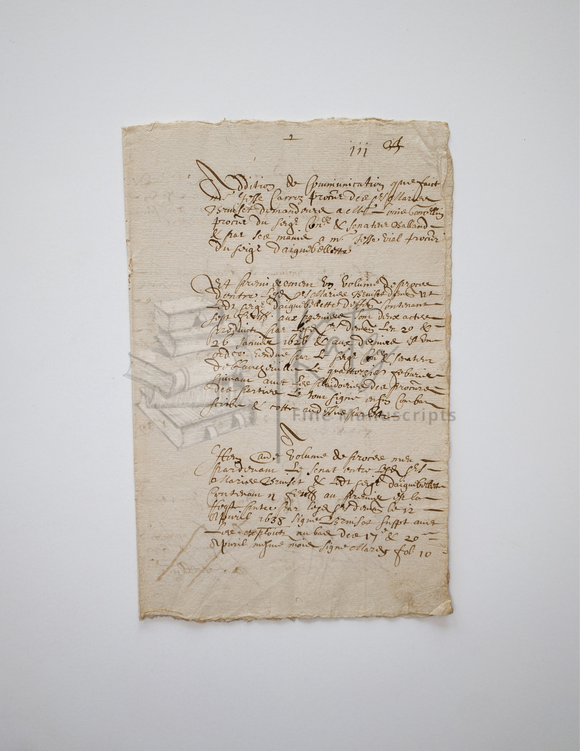
c. 17th Century Manuscript Extract After Edward Johnson on Indigenous Peoples of Early New England, Headed 1647
2211On offer is a remarkable early manuscript extract preserving a 17th-century English colonial description of Indigenous peoples in New England.
The text closely follows a passage from Edward Johnson’s important Puritan history, Wonder-Working Providence of Sions Saviour in New England, first printed in London in 1654.
Johnson’s work is one of the major early histories of Massachusetts Bay and Puritan New England, and this extract preserves his colonial description of Indigenous life, hunting, fishing, labor, clothing, and religious practice.
The passage is devoted almost entirely to English observations of Indigenous peoples in early New England, likely in the Massachusetts Bay context. It includes detailed descriptions of bows and arrows, fishing, trapping, hunting deer, beaver, otter, moose, birds, and fish, as well as comments on women’s labor, clothing, seasonal hardship, and domestic life. It also includes a reference to “Powawes,” an early English colonial term used for Indigenous spiritual or healing figures. The manuscript is headed “1647,” apparently as a chronological marker for the section being copied, rather than as the date the physical manuscript itself was written.
The language is strongly shaped by 17th-century Puritan colonial attitudes and includes offensive descriptions of Native peoples. It is best understood today as a colonial-era manuscript transcription preserving English settler perceptions of Indigenous life, rather than as a neutral ethnographic account.
An excerpt follows: “The Indian People in these parts at the English first coming were very barbarous and uncivilized going for the most part naked, although the country be extreme cold in the winter season; They are only clothed with a Deer skin, and a little bit of Cloth to cover their privy part. The Women for the most part are very modest, although they go as naked as the Men; They are generally very laborious at their planting time, and the Men extraordinarily idle, making squawes to carry their Children and the luggage beside…”
The passage continues with descriptions of hunting, fishing, trapping, bows and arrows, and English colonial interpretations of Indigenous religious practice, including reference to Indigenous healing charms.
HISTORICAL NOTE: Although the manuscript is headed “1647,” the heading should not be read as proof that the physical manuscript was written in that year. The text appears to be copied from, or closely based upon, Edward Johnson’s Wonder-Working Providence, which was completed after 1647 and first printed in 1654. The “1647” heading is therefore best understood as a chronological or historical marker within the copied material. A significant manuscript relic preserving early colonial New England commentary on Indigenous peoples, Puritan worldview, settler observation, and the manuscript transmission of early American historical texts.
Condition: Mild toning, minor spotting, smudging, and a horizontal fold near the end. The fragment has been backed with a thin supporting layer and mounted to a larger modern support sheet. Ink remains bold, dark, and legible throughout. Overall very good condition for a manuscript fragment of this age and type.
Please don't hesitate to contact us for more information or to request photos. (Kindly include the SKU, listed on this page above the price, in your e-mail so we can more easily answer your questions.)